Build vs Validate: Why Research Comes First
The build vs validate debate — why research before building saves months of wasted effort and how to validate demand signals properly.
Validate before you build
Check demand signals and get a validation report before writing any code.
Validate FirstThe most persistent debate in startup circles is whether to build first or validate first. Build-first advocates argue that the market will tell you what it wants once you put something real in front of people. Validate-first advocates argue that building something nobody wants is one of the most expensive and avoidable mistakes a founder can make. This isn't really a binary choice — it's a tradeoff, and the right answer depends on how expensive building actually is for your specific idea.
The startup graveyard is filled with technically impressive products that nobody needed — execution quality doesn't create demand that wasn't there to begin with. Ideas built against confirmed public demand signal tend to start from a stronger position than ideas built purely on a founder's hunch, though neither approach guarantees an outcome. This guide walks through the actual tradeoff, not just the slogan.
What You Risk by Building First
Building first costs you time, money, momentum, and focus — resources that are especially scarce for solo founders and small teams. There's also a psychological cost: the sunk cost of building creates emotional attachment to the idea as it exists, making it genuinely harder to pivot when the market gives you contradicting signal partway through or after launch.
What You Gain by Validating First
Validating first gives you public evidence that the underlying problem is discussed and searched for, clearer understanding of who your customer actually is and how they describe their problem, more efficient building because you're building toward something with existing signal instead of a guess, and the option to compare multiple ideas before committing fully to one.
When Build-First Can Make Sense
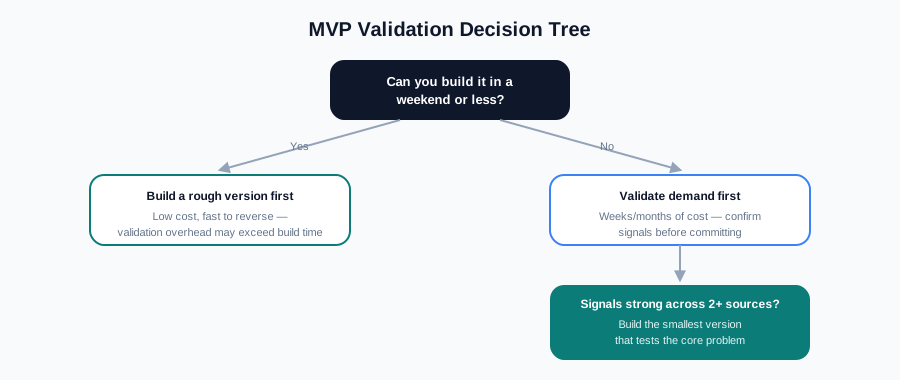
There is a real scenario where building first is reasonable: when the cost of building is genuinely lower than the cost of validating properly. For very small, low-cost side projects you can build in a weekend, the time spent on structured validation may exceed the time spent just building and seeing what happens. The tradeoff shifts as the build gets bigger, more expensive, or harder to walk away from.
A Simple Way to Decide
- 1Estimate your realistic build time and cost, including opportunity cost
- 2If it's a weekend or less and fully reversible, building first is a reasonable bet
- 3If it's weeks or months of committed time, validate first using public signal research and customer interviews
- 4Either way, define upfront what evidence would tell you to stop or pivot
How DemandProofHQ Makes Validating First More Practical
One real objection to validating first is that manual research takes real time — sometimes long enough that founders skip it and just build. DemandProofHQ compresses the public-signal research step from days of manual searching to minutes, which removes much of the time cost that makes build-first tempting in the first place. Start at /validate.
Frequently asked questions
Is validating first always the right choice?
Not always — for very cheap, fast, reversible builds, the validation overhead can exceed the build cost. It's a tradeoff based on cost and reversibility, not a universal rule.
Does validating first guarantee my idea will succeed?
No. It reduces the risk of building something with no public demand evidence, but it doesn't guarantee revenue, customers, or business outcomes.
What's the biggest risk of building first?
Sunk cost bias — once you've built something, it becomes psychologically harder to abandon or meaningfully pivot, even when the evidence suggests you should.
Can I validate and build in parallel?
For larger projects, a common approach is to validate the core assumption first, then build the smallest version while continuing to gather signal from early users.
DemandProofHQ helps review public demand signals, but it does not guarantee product-market fit or replace direct customer conversations.
Don't build before you validate
Check demand signals first with a structured validation report.
Validate FirstRecommended next steps