Demand Score Explained: How We Measure Market Demand
How demand scoring works at DemandProofHQ — the signals, weights, and methodology behind measuring market demand for startup ideas.
Get a demand score for your idea
Check demand signals and get a scored assessment of market opportunity for your concept.
Get My ScoreA demand score is a composite metric that estimates the strength of public market demand for a business idea, based on signals that are visible before you build anything. It helps founders answer a practical question: how much public evidence exists that people are already looking for this kind of solution? DemandProofHQ calculates a demand score by reviewing signals across several categories and weighting each by how reliably it tends to correlate with real commercial interest.
This guide explains what goes into the score, how the categories are weighted, how to read a score once you have one, and — just as important — what a demand score cannot tell you.
What Goes Into a Demand Score
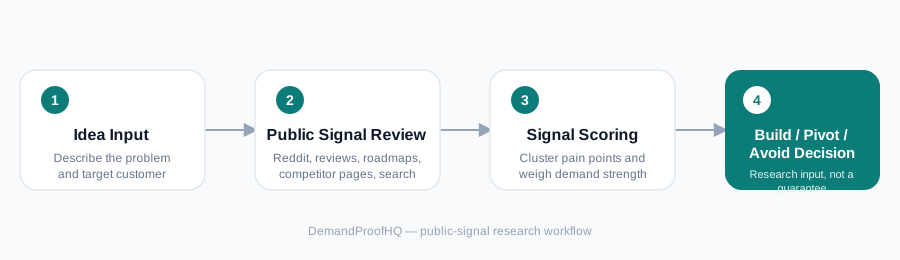
The demand score combines signals from multiple independent public sources. Each source provides a different type of evidence, and the score weights each type based on how strongly it tends to reflect genuine buyer interest rather than passive curiosity.
Reddit and community signals
Recurring pain points and feature requests pulled from real conversations, linked back to source threads so you can read the original context yourself. Community signals carry meaningful weight because they represent organic, unsolicited evidence — people describing a problem in their own words, without being prompted by a survey or a sales conversation.
Search demand signals
Buyer-intent keyword patterns and directional trends in your category. Search signals are weighted for commercial intent specifically. Terms containing phrases like "best," "alternative to," "software for," or "pricing for" indicate someone is comparing options, not just researching a topic out of curiosity.
Competitor signals
Evidence that competitors exist and have active, paying customers is one of the strongest demand confirmations available — someone else has already proven people will pay to solve this problem. Competitor gap signals, pulled from critical reviews and public feature request boards, reveal where those existing solutions are falling short.
Buyer intent language
Beyond raw keyword volume, the score looks at how people phrase their problem across sources. Language like "is there a tool that" or "looking for something that can" signals active shopping behavior. Purely informational phrasing, like "what is" or "how does X work," signals curiosity rather than intent to buy.
How the Categories Are Weighted
Not every signal category counts equally. Community and competitor signals are generally weighted more heavily than raw search volume, because they represent direct, unprompted evidence of a problem rather than an ambiguous search query that could mean several different things. A single category with strong evidence is informative, but a score built on convergence — multiple independent categories all pointing the same direction — is meaningfully more reliable than any one category alone.
How to Interpret Your Demand Score
The demand score is a tool to help you prioritize and decide where to invest further research time — it is not a guarantee of success. A high score suggests strong, consistent signals across multiple independent sources, which is a reasonable foundation to justify deeper validation work like customer interviews or a landing page test. A medium score suggests some signals exist but need closer investigation before you commit meaningfully. A low score suggests the available public evidence is thin, which does not necessarily mean the idea is bad — it may mean the market is early, niche, or simply not well represented in the public data sources the score reviews.
The most practical use of a demand score is comparison. Score several ideas using the same methodology and use the relative differences to decide where to focus your limited research time first. See a sample demand score breakdown at /sample-report.
Common Mistakes When Reading a Demand Score
- Treating a high score as a guarantee instead of a research prioritization signal
- Ignoring a low score in a category you personally believe is important, without investigating why the signal is weak
- Comparing scores generated at different times without accounting for how public signals shift
- Skipping direct customer conversations because the score already looked favorable
- Using the score as the only input instead of one part of a broader validation process
Frequently asked questions
Is a demand score the same as market size?
No. A demand score reflects the strength and consistency of public signals suggesting people want a solution — it does not estimate total addressable market size or revenue potential.
Can a low demand score still mean I should build?
It can. A low score often means public signal coverage is thin, which is common for very new or very niche categories. In that case, direct customer interviews become more important, not less.
How often should I re-check my demand score?
Public signals shift over time as communities, competitors, and search behavior change. Re-checking before a major build decision, rather than relying on an old score, is good practice.
Does a high score mean I don't need customer interviews?
No. Public signals confirm that a problem is being discussed publicly, but customer interviews confirm depth, willingness to pay, and fit with your specific solution. Use both together.
DemandProofHQ helps review public demand signals, but it does not guarantee product-market fit or replace direct customer conversations.
Get your demand score
Run a demand check and see how your idea scores across key validation dimensions.
Score My IdeaRecommended next steps