How DemandProofHQ Works: Structured Idea Validation
How DemandProofHQ works — from idea input to structured public-signal analysis to a validation report with a clear, evidence-linked verdict.
Try DemandProofHQ on your idea
Enter your concept and get a structured validation report in minutes.
Validate My IdeaDemandProofHQ is a structured demand validation tool that helps founders check whether public evidence of market demand exists for their startup idea before they build. It is a public-signal research workflow, not a crystal ball — here is exactly how it works, from idea input to validation report, and what it can and can't tell you.
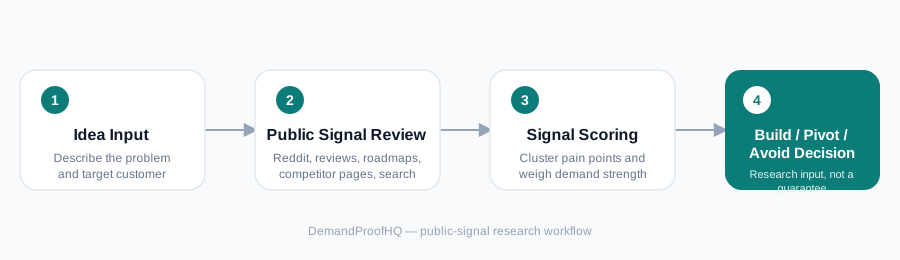
Step 1: Enter Your Idea
Start by describing your startup concept. Tell us who your target customer is, what problem you're solving, and how your solution works. The more specific you are, the more precisely the tool can search for relevant public signal — vague inputs produce vague results, in any research process.
Step 2: Scan Public Signals
The system scans public data sources including Reddit conversations, product reviews on G2 and Capterra, feature request boards, competitor roadmaps, and search behavior patterns. It looks for signals that people are actively discussing or seeking a solution to the problem you described.
Step 3: Score and Structure the Signals
The signals found are aggregated and scored using a transparent, rules-based methodology — not a black box. The report includes a demand score, a competitor snapshot, a market risk assessment, search trend context, and a recommended set of next steps, each linked back to its source so you can verify it yourself.
Step 4: Get Your Verdict
Every report ends with a directional recommendation: Build, Pivot, or Avoid. This is based on the combined strength of signals across all categories. It is a decision aid, not a guarantee — it gives you evidence-backed context before you invest months building, but the decision, and the responsibility for verifying it, is yours.
What Makes DemandProofHQ Different
DemandProofHQ combines multiple signal types into a single report rather than relying on one data source. Many validation approaches focus narrowly on keywords, or surveys, or interviews alone. DemandProofHQ combines search signals, community signals, competitive signals, and buyer intent language to provide a fuller demand picture in one place. View a sample at /sample-report.
What DemandProofHQ Cannot Tell You
- Whether you specifically will execute well enough to win the market
- Exact revenue, customer count, or funding outcomes
- Private or non-public data that isn't visible through the sources it scans
- Whether the market will still look the same by the time you launch
How to Use a DemandProofHQ Report
Treat the report as a structured starting point, not a final verdict. Use the source-linked signals as a shortcut to the research you'd otherwise do manually across a dozen tabs, then follow up with direct customer conversations to test problem depth and willingness to pay before you commit meaningful build time.
Frequently asked questions
Does DemandProofHQ use artificial intelligence to write my report?
Report scoring is based on structured, rules-based analysis of public signals rather than generative AI. The value comes from systematically pulling and scoring public data quickly, not from machine-generated predictions.
How long does a report take to generate?
A report is typically ready within minutes of entering your idea details.
Is the demand score a guarantee of success?
No. It reflects the strength of available public signals at the time of the scan, not a guarantee of revenue, customers, or business outcomes.
Can I see what a report looks like before signing up?
Yes — view a full example at /sample-report.
DemandProofHQ helps review public demand signals, but it does not guarantee product-market fit or replace direct customer conversations.
See how DemandProofHQ works for your idea
Enter your startup concept and get a full validation report with demand score and analysis.
Validate My IdeaRelated articles
Recommended next steps